
2026 AI Chip Industry Report: Supply & Demand, Domestic Substitution, Memory & Optical Chips | 100+ Report PDFs, Data & Visualization Templates Download
This article analyzes core issues in China’s AI chip industry, addressing five key questions: 1. The specific scale and changing trends of the China AI chip supply-demand gap in 2025; 2. The pace of market share growth for domestic AI chips and the 2027 target; 3. The differentiated competitive landscape and commercialization progress of leading domestic AI chip manufacturers; 4. The prosperity and domestic substitution potential in the memory and optical chip sectors; 5. Core industry risks and strategies for SMEs and industrial capital.

The complete research report data, charts, and the 100-plus chip industry reference report collection at the end of this article have been shared in our membership group. Click to read the full article and join the group for consultation, custom data, and reports.
In this era of comprehensive AI computing infrastructure rollout, the global semiconductor industry is shifting its focus toward AI chips. China’s market is forging its unique industrial upgrading path under the dual thrust of export controls and independent innovation. AI chip supply-demand imbalance, rapid growth in domestic market share, gradual improvement of software ecosystems, and the simultaneous boom in memory and optical chips together form the core development landscape of the current chip industry. Bernstein’s “2025 China AI Chip Industry Big Report: Assessing China’s AI Chip Supply and Demand” and Hunan University’s “2025 Domestic AI Chip Software Ecosystem White Paper” provide precise data support and trend judgments for industry development. This report references Bernstein’s “2025 China AI Chip Industry Big Report,” Hunan University’s “2025 Domestic AI Chip Software Ecosystem White Paper,” and the 100-plus chip industry research reports and data at the end of this article.
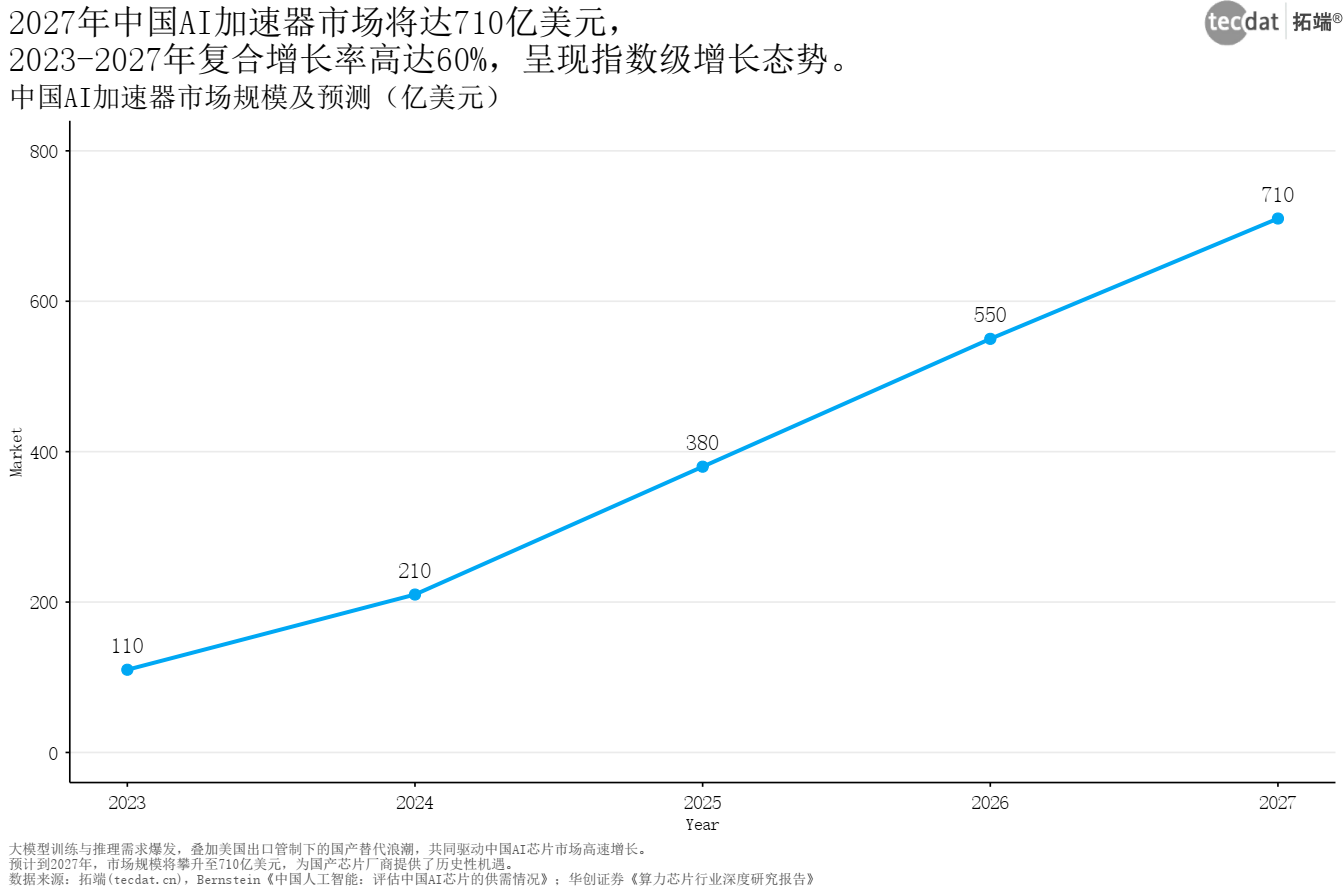
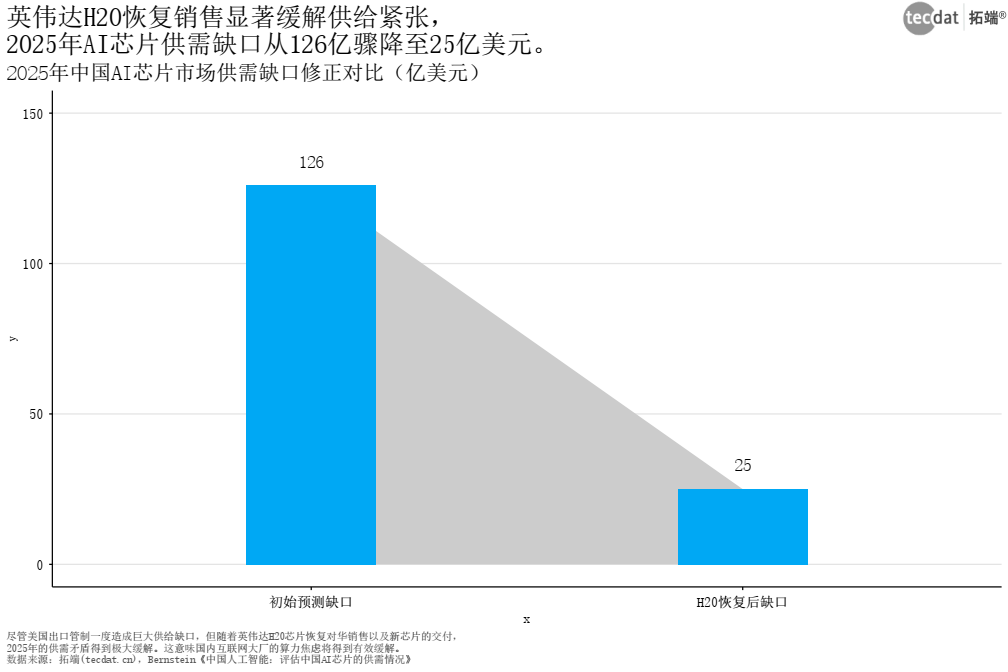
Sustained explosive growth in AI computing demand has kept China’s AI chip market at high prosperity, with overall demand reaching $39.5 billion in 2025. Even with NVIDIA’s H20 chip resuming sales to China, total annual market supply could only reach $37 billion, leaving a supply-demand gap of $2.5 billion—a significant narrowing from the originally projected $12.6 billion gap. US export controls have objectively created a development window for domestic chip manufacturers, pushing the market share of domestic AI chips from 17% in 2023 to a projected 55% by 2027. The industry logic is shifting from supply-constrained to demand-constrained. China’s AI accelerator market maintains strong growth, with a CAGR of 60% from 2023 to 2027, reaching $71 billion in 2027. The surge in demand from large model training and inference scenarios is the core driver. Chart data and PDF templates for Chart 1 (China AI Accelerator Market Size Trend) have been shared in the membership group.
Most Viewed Insights
- 2026 Robotics Industry Frontier Insight Report: Humanoid & Special Robots — Certification, Manufacturing to Consumer
- 2026 AI Future Report: Agents, Metaverse, Education & Commercialization | 400+ Report PDFs, Data & Visualization Templates
- 2026 AI Healthcare Industry Special Report: Smart Medical Devices, Surgical Robots, BCI & Wearables | 240+ Report PDFs
- 2025 Autonomous Driving Intelligence Report: From L2 Parity to L4 Commercialization — Resonance of Technology, Cost & Policy | 120+ Report PDFs
- 2025 Cross-Border E-Commerce Globalization & Compliance Operations Report: Market Trends, Tax Policy & Complaint Insights | 140+ Report PDFs
The resumption of NVIDIA H20 chip sales is the key factor in narrowing the supply-demand gap. NVIDIA can complete $10.5 billion in H20 order deliveries from September to December 2025, and with the market contribution of the new B30 chip at $280 million, domestic computing power shortages are effectively alleviated. ByteDance, Alibaba, Tencent, and Baidu are the core purchasers of H20 chips, accounting for over 80% of total demand in 2024. H20 supply recovery will directly drive rapid AI business advancement for top internet companies. Chart data and PDF templates for Chart 2 (China AI Chip Supply-Demand Gap Narrowing) have been shared in the membership group.
The market share of domestic AI chips continues to climb, reaching 37% in 2025. Huawei Ascend, Cambricon, and Hygon Information form the first tier of domestic chip manufacturers, gradually capturing overseas market share through policy support and technological iteration. Chart data and PDF templates for Chart 3 (Domestic AI Chip Market Share Trend) have been shared in the membership group.
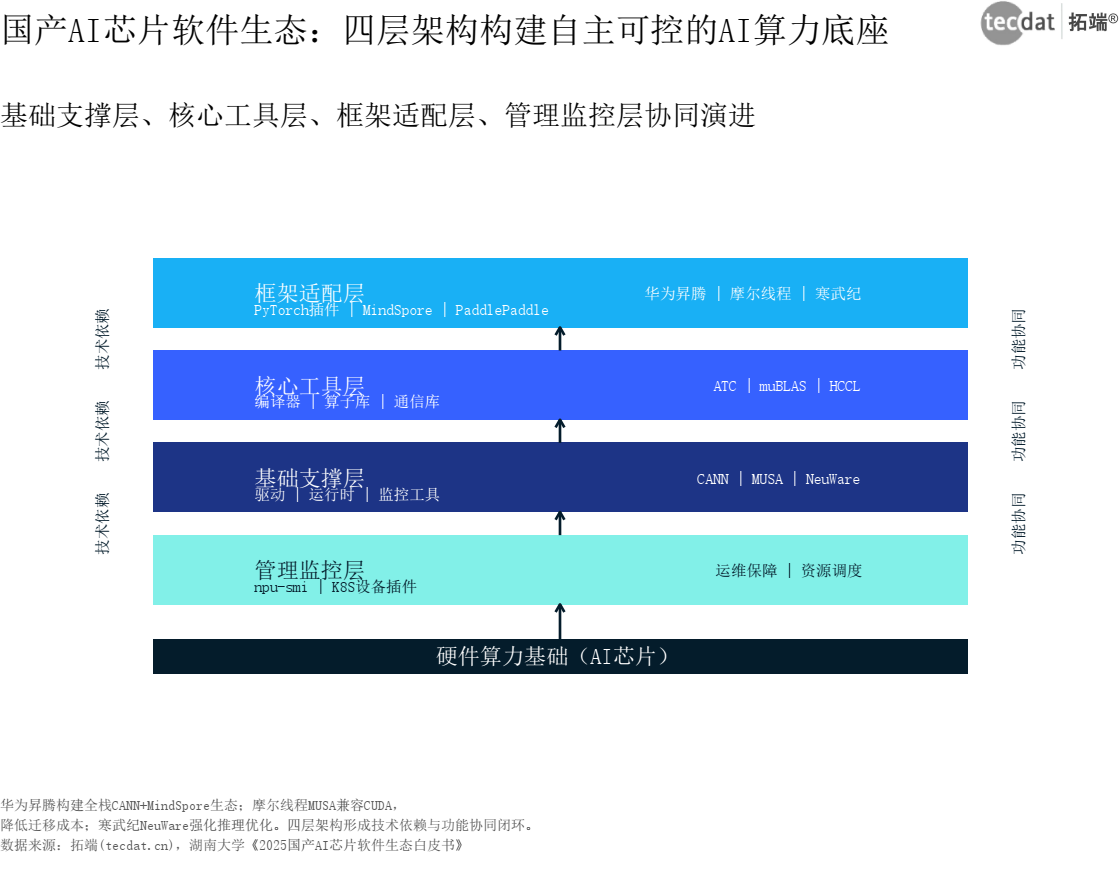
Domestic AI chip software ecosystems have formed a clear four-layer architecture system, including the framework adaptation layer, core tool layer, basic support layer, and management monitoring layer. These four layers work in efficient synergy based on hardware computing power. Huawei Ascend builds a full-stack software ecosystem through CANN + MindSpore, while Moore Threads MUSA and Cambricon NeuWare focus on CUDA compatibility and inference optimization respectively, forming differentiated ecosystem layouts. PDF templates for Chart 4 (Four-Layer Architecture of Domestic AI Chip Software Ecosystem) have been shared in the membership group.
From an ecosystem maturity perspective, NVIDIA’s CUDA has built extremely high industry barriers through a comprehensive developer system. Huawei Ascend’s CANN community leads among domestic players, while Cambricon, Hygon and other manufacturers’ software ecosystems are still in the cultivation stage. High software ecosystem adaptation costs remain the core obstacle to large-scale domestic chip deployment, with CUDA compatibility being the key lever for domestic manufacturers to break through the market. Chart data and PDF templates for Chart 5 (Mainstream AI Chip Software Ecosystem Radar) have been shared in the membership group. Interpretation: SMEs and AI companies should prioritize selecting domestic chip solutions with stronger compatibility to effectively reduce technology migration costs. Industrial capital can focus on the ecosystem adaptation tool sector to fill the industry toolchain gap.
Domestic AI chip manufacturers have formed four competitive tiers. Huawei Ascend, Cambricon, and Hygon Information constitute the first tier, while Matrix Labs and Moore Threads make up the second tier. Different manufacturers have significant differences in technical routes, application scenarios, and commercialization progress. Chart data and PDF templates for Chart 6 (Domestic GPU厂商 Revenue Comparison) have been shared in the membership group.
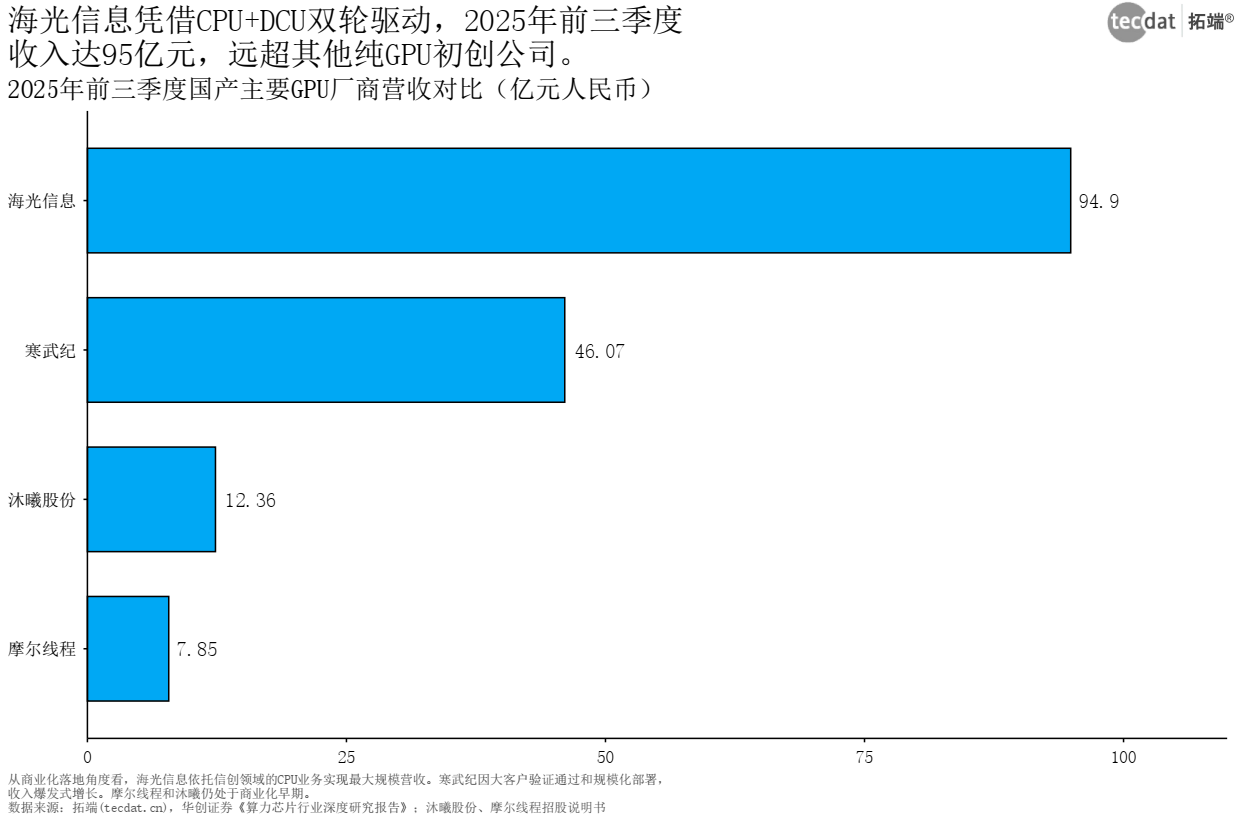
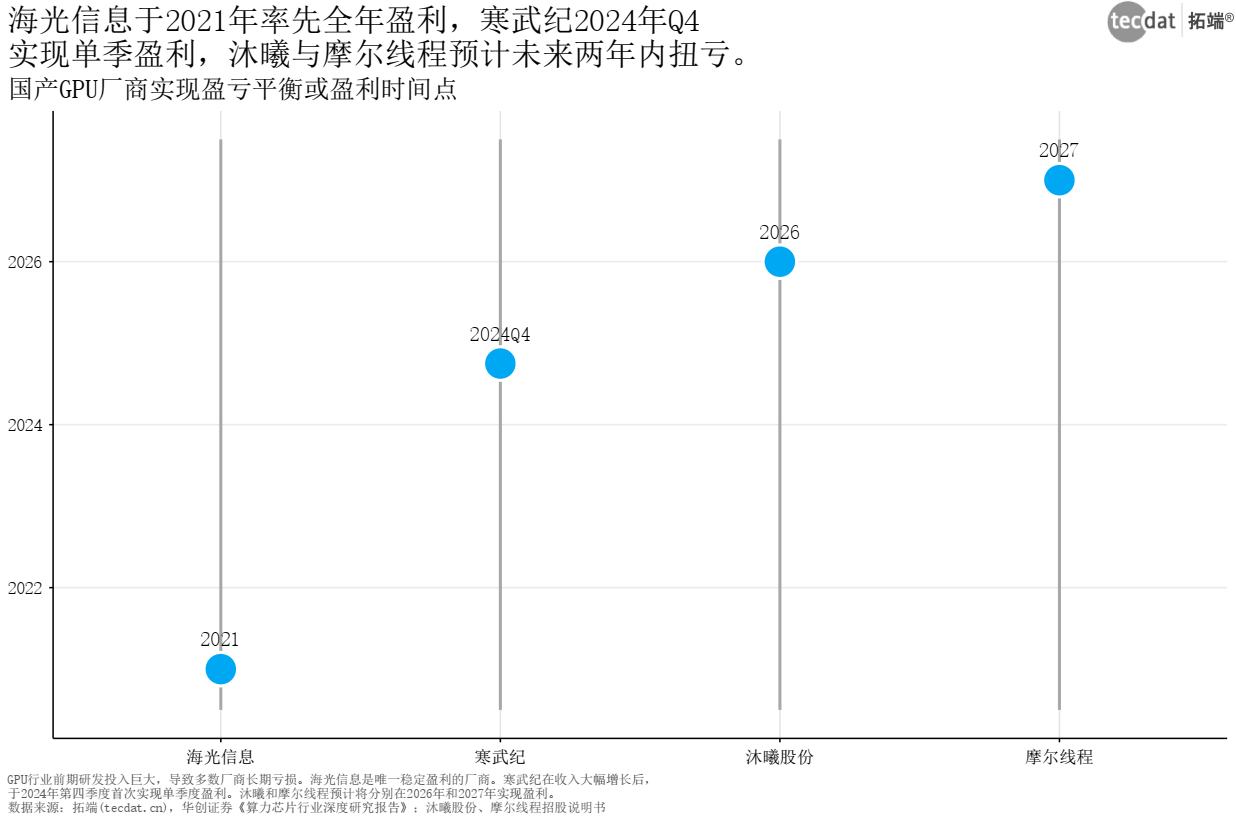
In terms of profitability progress, Hygon Information achieved full-year profitability as early as 2021, Cambricon turned profitable in Q4 2024, while Matrix Labs and Moore Threads are still in the early commercialization stage, expected to reach break-even around 2026–2027. High R&D investment and dependence on advanced process nodes are industry-wide challenges. Leading manufacturers break through profitability bottlenecks first by leveraging premium大客户 resources. Chart data and PDF templates for Chart 7 (Domestic GPU Break-Even Timeline) have been shared in the membership group.
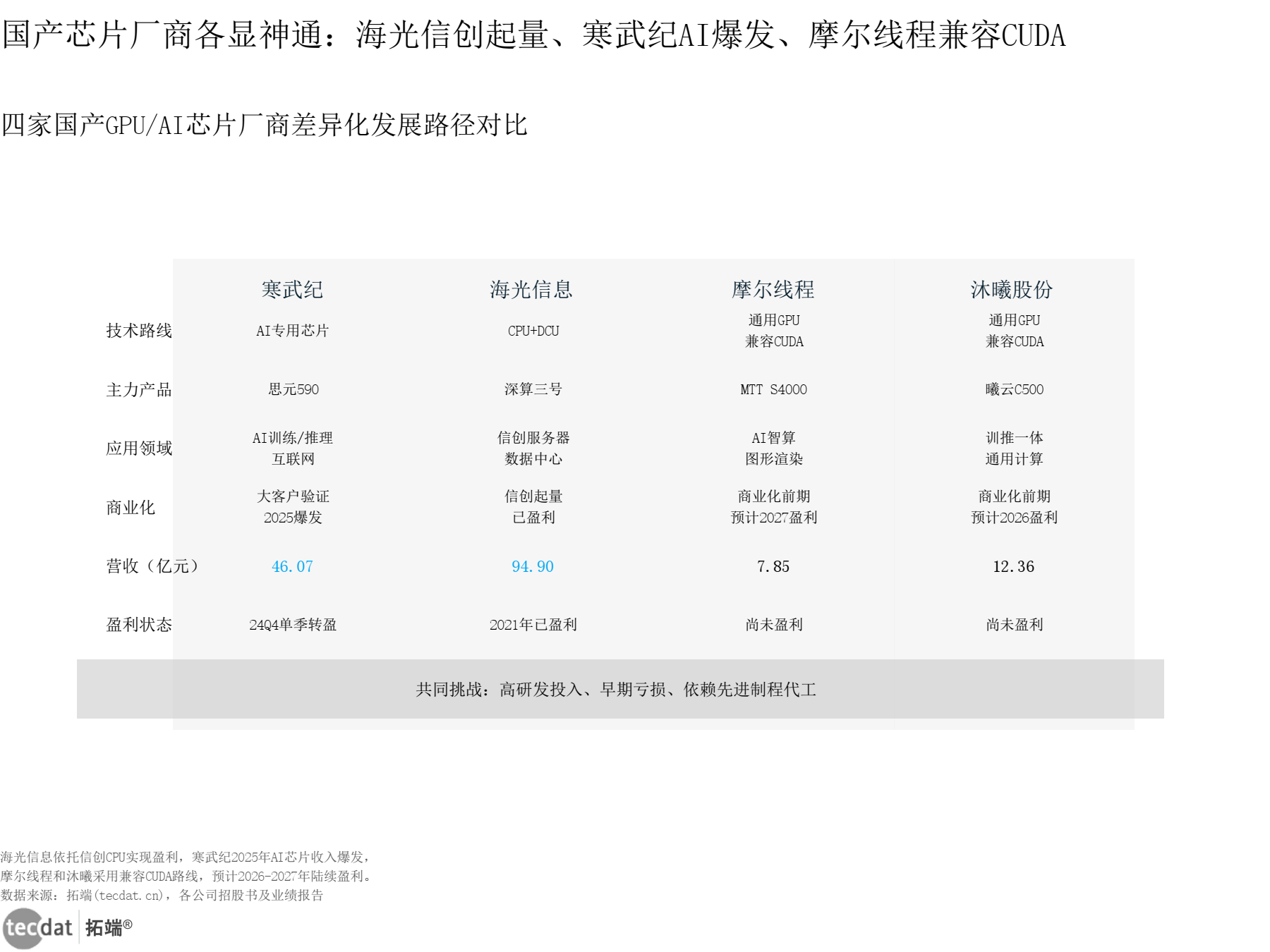
Interpretation: SMEs should prioritize selecting mature domestically-produced chip products that have achieved commercial deployment to effectively reduce cooperation risks. Industrial capital should focus on manufacturers that have obtained大客户 validation and have clear profitability inflection points, avoiding risks in early R&D stages.
AI computing power demand has fundamentally reshaped the storage chip market structure, with the server segment surpassing consumer electronics to become the largest application scenario. By 2029, the server storage market will reach $145.8 billion, while AI edge-side storage leads all sub-sectors with a 36.4% CAGR. Chart data and PDF templates for Chart 8 (Storage Chip Downstream Application Market Size Growth) have been shared in the membership group. In 2026, the global storage chip market enters a boom phase, reaching $551.6 billion, a year-on-year increase of 134%, officially entering the super cycle defined by AI. Supply-demand mismatch between proactive production cuts by storage OEMs and explosive market demand has driven DDR4 prices up by 1800%, pushing the storage chip market into a seller’s market phase. Chart data and PDF templates for Chart 9 (Storage Chip Market Size & Growth Dual-Axis) have been shared in the membership group.
On the demand side, AI server storage demand grows at 50% growth rate, far ahead of traditional data centers, automotive electronics, and consumer electronics. HBM has become the core direction for storage chip technology iteration, with HBM4 product bandwidth expected to exceed 2TB/s. Chart data and PDF templates for Chart 10 (Storage Chip Demand Growth) have been shared in the membership group. On market structure, SK Hynix tops the DRAM market with its HBM product advantages at 38.2% market share, while Changxin Storage’s DRAM market share exceeds 5%. Yangtze Memory’s Xtacking architecture achieves 14% NAND market share. Domestic storage manufacturers achieve breakthroughs in both technological capability and market share. Chart data and PDF templates for Charts 12–13 (DRAM & NAND Market Structure Donut Charts) and Chart 5 (Storage Chip Domestic Breakthrough Timeline) have been shared in the membership group.
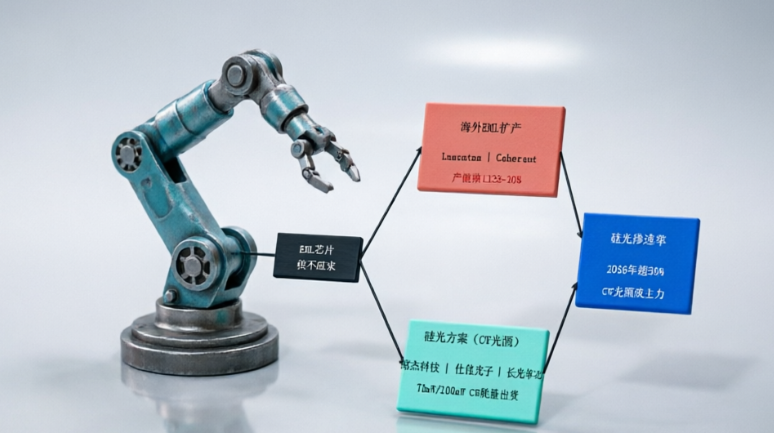
AI computing power explosion drives急剧 growth in 800G/1.6T optical module demand. EML chip capacity shortfall reaches 25%–30%, with orders booked through 2027 and beyond. Overseas manufacturers long monopolize the高端 optical chip market. Silicon photonics solutions achieve accelerated penetration, exceeding 50% market share in 2026. CW light sources become the main product for domestic substitution, with domestic manufacturers such as Yuanjie Technology and Shijia Photonics achieving mass shipment. Chart data and PDF templates for Chart 4 (Optical Chip Supply Chain Bottleneck & Silicon Photonics Substitution) have been shared in the membership group.
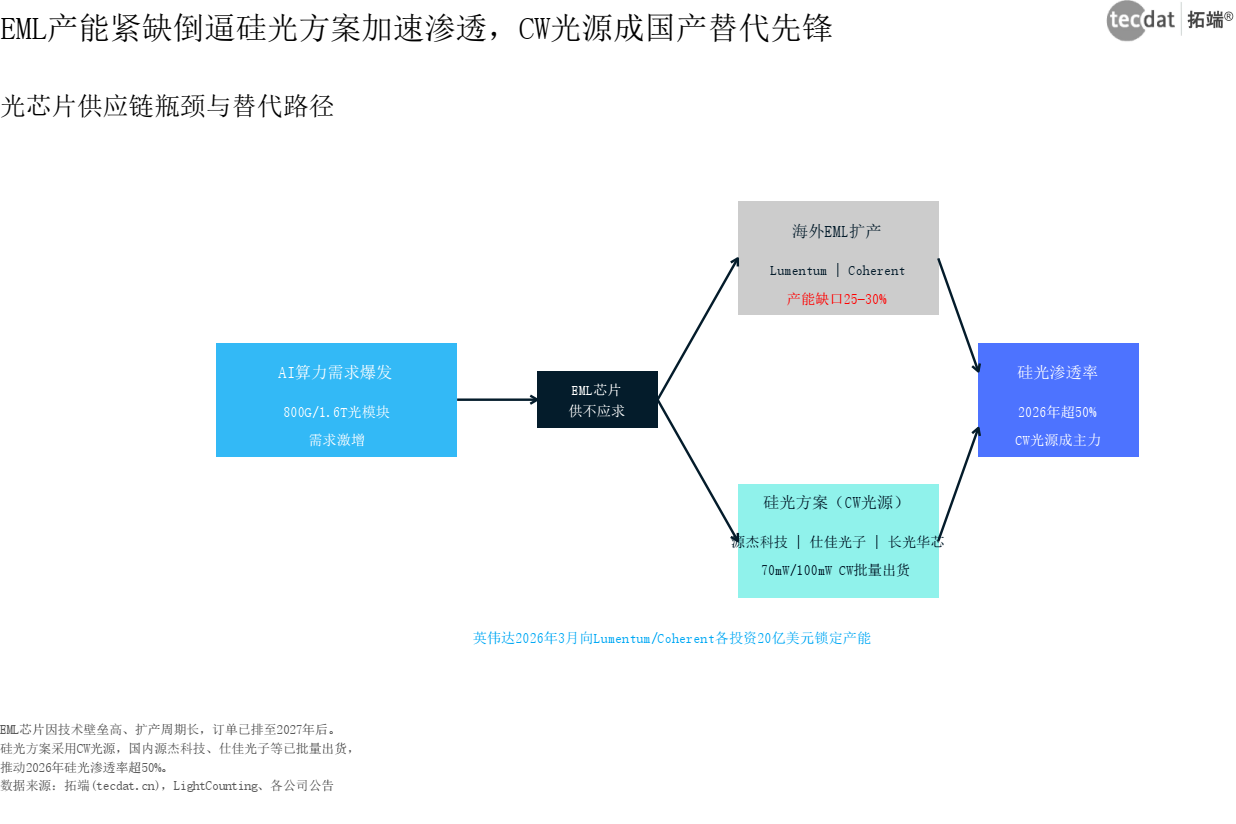
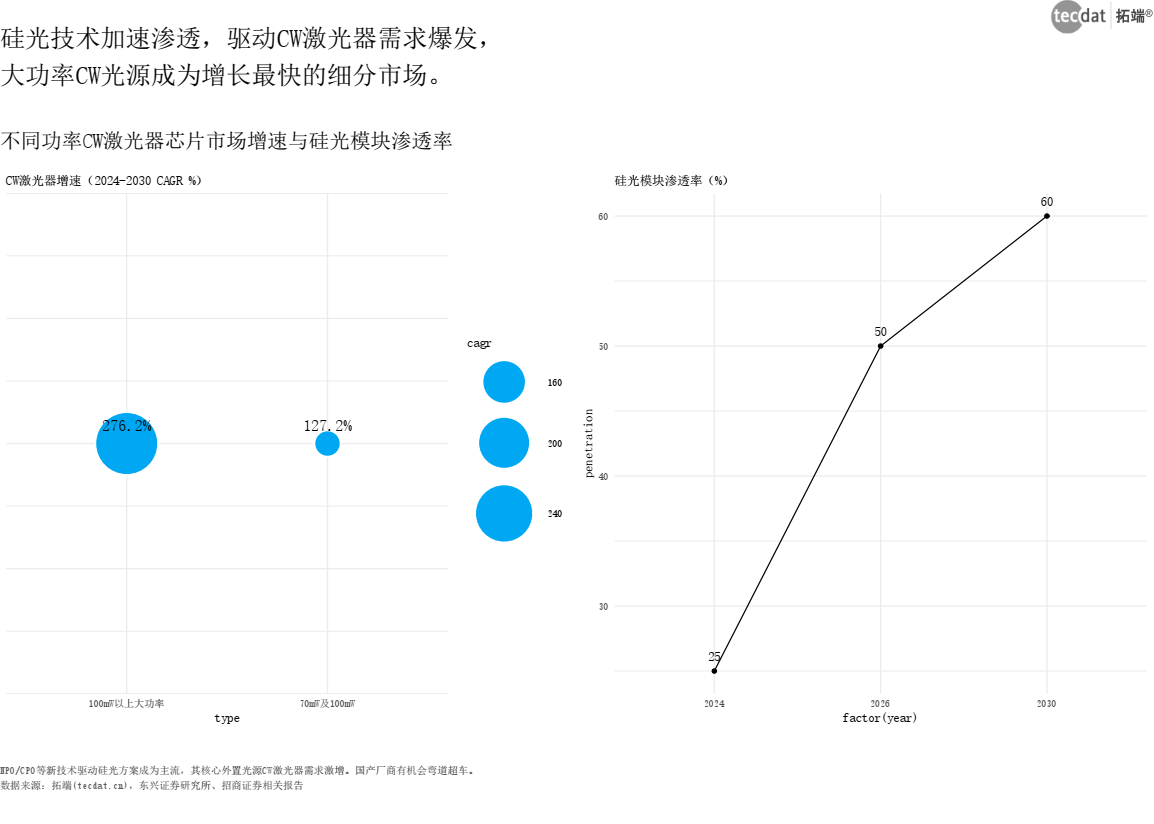
Chart data and PDF templates for Chart 16 (Optical Chip Market Structure & Supply-Demand Gap) and Chart 17 (CW Laser Growth Rate & Silicon Photonics Penetration) have been shared in the membership group. CW laser technology is the fastest-growing segment in the industry, with high-power products above 100mW achieving a CAGR of 276.2% from 2024 to 2030. The global optical chip market will reach $22.9 billion by 2030, nearly nine times the 2024 level.
Interpretation: SMEs can enter the sector by focusing on silicon photonics components and CW light source supporting links. Industrial capital should focus on domestic optical chip manufacturers to seize domestic substitution opportunities against the backdrop of capacity shortage.

2026 Global & China Semiconductor Manufacturing Market Forecast and Chip Industry Analysis Report: AI-Driven, Localization, Advanced Packaging & Lithography Technology | 100+ Report PDFs, Data & Visualization Templates
In-depth analysis of semiconductor manufacturing and the chip industry, covering core topics including AI-driven growth, localization progress, advanced packaging, and lithography technologies.
Explore InsightsThe comparative analysis shows that Bernstein’s report core conclusions are a 2025 AI chip gap of $2.5 billion and 55% localization rate by 2027, based on actual shipment data from NVIDIA and AMD plus domestic manufacturer capacity calculations. The supply-demand gap forecast is precise and the localization rate prediction is clear. Hunan University’s white paper points out that the four-layer domestic ecosystem architecture has taken shape, with CUDA compatibility as the key, based on actual application scenarios of domestic manufacturers’ software stacks. The ecosystem layer division is clear and focuses on software adaptation pain points. The computing chip industry deep-dive report shows domestic GPU commercialization differentiation with Hygon and Cambricon leading, combining listed company public financial reports and channel survey data—厂商 revenue and profitability data are consistent with financial reports.
Actionable Checklist: SMEs should prioritize using mature domestic chips from Huawei Ascend and Hygon DCU, partnering with leading厂商 to reduce technology adaptation costs, and focus on inference scenarios for AI application deployment. Brand strategy leaders should layout AI computing infrastructure procurement, prioritizing dual-supply solutions locking in both NVIDIA H20 and domestic chips to avoid supply chain disruption risks. Industrial capital investment departments should focus on domestic memory chip and optical chip manufacturers, as well as the AI chip ecosystem adaptation tool sector, seizing the commercialization dividend of 2026–2027.
Risk Warnings & Mitigation Plans: Risk of US export control escalation may lead to continued restrictions on advanced processes and software ecosystems. Mitigation: pre-emptively layout mature process capacity, increase self-developed software ecosystem investment, and share domestic substitution supply chain resources within the community. Risk of industry overcapacity: the industry shifts to demand-constrained in 2027 with intensified price wars. Mitigation: focus on differentiated competition in niche scenarios, lock in long-term orders in advance, and connect downstream application demand resources within the community. Risk of technology iteration: global厂商 continuously upgrade technology, widening the domestic gap. Mitigation: increase R&D investment, focus on advantageous scenarios such as inference and edge computing, and coordinate industry-university-research resources within the community to advance technological breakthroughs.
Summary: China’s AI chip supply-demand gap narrowed to $2.5 billion in 2025, with NVIDIA H20 resuming supply alleviating short-term pressure, while long-term domestic substitution remains the core trend. Domestic AI chip market share will reach 55% by 2027, with software ecosystem and commercialization capability as the core competitiveness of manufacturers. Hygon, Cambricon, and Huawei Ascend lead the industry. The memory and optical chip sectors benefit from AI computing power explosion, with domestic manufacturers achieving breakthroughs in DRAM, NAND, and CW light sources, offering vast substitution potential. SMEs and industrial capital should focus on mature deployment scenarios, avoid overcapacity and technology iteration risks, and seize the golden window for domestic substitution. To obtain all report data at the end of this article, join the group chat and add our assistant WeChat: tecdat_cn.
Reference Reports (PDF) in This Topic
-
Advanced Packaging Tri-Rhythm Enters 2027 Price Gap Period: Unimicron ABF Shortfall 35%, MediaTek TPU Coordinated Chip Ramp-Up, CoWoS Full Load — 10,000-Word Complete Analysis.pdf2026-05-08 14:49
Optical Chip Industry Deep Report: Supply-Demand Gap Persists, Domestic Optical Chip厂商 Growth Space Opens.pdf2026-05-07 14:54
Beijing Auto Show Preview: Independent & New Forces Advance ADAS & Self-Developed Chips in Parallel, Joint Venture China Solutions Lead Smart-Electric Transformation.pdf2026-04-29 15:19
Communications Optical Interconnect Industry: CW Laser Reconstructs Global Optical Chip Industry Landscape, IDM Model Builds Industry Chain Barriers.pdf2026-04-28 15:32
2026 HSMT Technology Industry Application White Paper — China Automotive Chip Standard Testing & Certification Alliance.pdf2026-04-13 15:21
Optical Chip Industry Deep Dive: Market Structure, Development Space, Industry Chain & Related Companies Comprehensive Analysis.pdf2026-04-06 17:00
AI Chip Shortage: When Computing Power Becomes Scarcer Than Electricity.pdf2026-04-05 12:33
Caitong Securities — NVIDIA NVDA.US: From AI Chip to Computing Factory, Ecosystem Barriers Continue to Consolidate.pdf2026-04-03 15:12
Steering the Beam — Core Leap of Phased Array T_R Chips in Civil-Military Integration & Intelligent Waves: Leopard Entry Report Series.pdf2026-04-01 15:26
AI Ignites Supply-Demand Gap, Optical Chips Welcome Golden Opportunities.pdf2026-03-29 08:58
Deep Report: 2026 Global Storage Chip Industry Development Trends Deep Analysis.pdf2026-03-27 15:22
2025 China Phased Array T_R Chip Industry Overview: Opening Civil-Military Dual-Use New Ecosystem (Essence Edition).pdf2026-03-18 15:44
2026 Global Display Driver IC (DDIC) Market Size, Industry Chain Transfer Direction & Leading Enterprise Analysis Report.pdf2026-03-17 15:36
2025 China Storage Chip Market Status & Benchmark Enterprise Operation Data Analysis Report — iMedia Research.pdf2026-03-11 16:06
Understand the Industry Chain in One Article: How Far Can This Round of Storage Chip Price Hikes Go?.pdf2026-03-05 14:47
2026 Edge-Side AI Industry Deep Dive: Application Iteration Drives Terminal Reconstruction, Witnessing Value Reassessment & Rank Upgrade of Edge-Side SoC Chips.pdf2026-03-05 14:46
Communications Industry Deep Report: Super Node — Comprehensive Upgrade of Optics, Liquid Cooling, Power Supply & Chips — OpenSource Securities.pdf2026-03-02 16:08
Electronics Industry Deep Report: 2026 Edge-Side AI Industry Deep Dive — Application Iteration Drives Terminal Reconstruction, Witnessing Value Reassessment & Rank Upgrade of Edge-Side SoC Chips.pdf2026-02-27 15:49
2026 Storage Chip Market Demand, Competitive Landscape & Domestic厂商 Layout Analysis Report.pdf2026-02-10 15:57
Diamond Thermal Conductivity Industry Deep Dive: Chip Integration Development Drives New Blue Ocean for Material Applications.pdf2026-02-10 15:52
Communications Industry Deep Report: Super Node — Comprehensive Upgrade of Optics, Liquid Cooling, Power Supply & Chips.pdf2026-02-05 17:10
Automotive SoC Report: Smart Driving Computing Power Leap Accelerates Realization, Domestic Ecology Drives Structured Expansion of Automotive-Grade Chips.pdf2026-02-03 16:15
Semiconductor Industry Analysis Manual II: Hybrid Bonding Equipment — Chip Interconnect Revolution in the AI Computing Era & BESI’s Navigation Path.pdf2026-02-03 16:15
EDA Tools: Spanning the Full Process of Chip Landing, Domestic Enterprises Preparing for Takeoff.pdf2026-02-03 16:15
Electronics Industry Deep Report: Blue Ocean Gathering in Optical Communications — Analog Chips & Liquid Cooling Have Great Potential.pdf2026-02-02 16:03
Semiconductor Industry Analysis Manual II: Hybrid Bonding Equipment — Chip Interconnect Revolution in the AI Computing Era & BESI’s Navigation Path.pdf2026-01-30 15:55
Electronics Industry Deep Report: Blue Ocean Gathering in Optical Communications — Analog Chips & Liquid Cooling Have Great Potential.pdf2026-01-29 14:38
AI Hardware Industry 2026 Strategy Report: AI Hardware in Its Infancy, Smart Computing Chips & PCB Localization Are Timely.pdf2026-01-12 15:14
AIDC Power Industry Series Research No.2: Two Key Directions of AI Power — ACDC Modules & Power Management Chips!.pdf2026-01-12 15:14
Jinyuan Securities: Electronics Industry Advanced Packaging Solves Chip Problems — Breakthrough in the Packaging Moore Era.pdf2026-01-09 16:58
Computing Chip Industry Deep Dive: Driving Factors, Development Overview, Domestic Substitution, Industry Chain & Related Companies Comprehensive Analysis.pdf2026-01-09 16:58
Computing Chip Industry Deep Research Report: Computing Revolution Rises in Waves, Domestic GPUs Forge Ahead with Determination.pdf2026-01-06 15:16
Computer Industry Deep Report: Domestic EDA Opportunities and Challenges Coexist — Domestic EDA M&A Wave Surges, AI + Advanced Process Drives the Rise of “Mother of Chips”.pdf2026-01-05 15:53
Electronics Industry Deep Report: AI Infrastructure, Optical & Copper — Mainstream Computing Chip ScaleUp-Out Solutions Fully Analyzed.pdf2025-12-30 14:39
Computing Chip Industry Deep Research Report: Computing Revolution Rises in Waves, Domestic GPUs Forge Ahead with Determination.pdf2025-12-30 14:37
2025 Domestic & International Cloud厂商 Computing Power Construction Status, Self-Developed Chip Layout & Progress Analysis Report.pdf2025-12-12 17:03
Smart Driving Chip Industry: Technology普惠 Rises with the Wind, Domestic Substitution Is Timely.pdf2025-11-26 15:34
Hunan University: 2025 Domestic AI Chip Software Ecosystem White Paper.pdf2025-11-21 16:40
Shuoyuan Consulting: 2025 China Smart Chip Industry Market Insight Report.pdf2025-11-21 16:38
3D Printing Industry Research: Responding to AI Chip Thermal Revolution, 3D Printed Liquid Cooling Plates Hold Broad Prospects.pdf2025-11-07 16:20
2025 From Chip to Automobile: In-Depth Discussion of ADAS & Robotaxi Report (English Version).pdf2025-11-05 16:46
2025 Amazon AWS Full-Stack AI Strategy: From Self-Developed Chips to Investment in Anthropic to Top-Level Application Layout Analysis Report.pdf2025-10-27 16:15
And 100+ other selected chip industry reports have been shared in the membership group (join the group for the full directory)
每日分享最新报告和数据资料至会员群
关于会员群
- 本会员社群以垂直产业数据研究、深度行业报告分享、AI数据工具实操交流为核心定位;
- 入群即可解锁全行业数据内容免费阅读与下载权限,同步更新海内外一手优质研究报告文档与产业数据;
- 会员老用户享受专属 9 折续费优惠,可长期锁定社群全部权益;
- 为会员提供一对一免费 PDF 报告专属代找服务。
非常感谢您阅读本文,如需帮助请联系我们!
 2026 Humanoid Robots: From Technological Breakthroughs to Ecosystem Definition | 200+ Reports, Data and PPT Collection Download
 2026 Humanoid Robot Industry Research Report: Mass Production Year, Core Components and Investment Landscape
 2026具身智能产业研究报告:量产元年,资本与数据卡位战 | 附100+报告、数据合集
 2026 Brain-Computer Interface (BCI) Industry In-Depth Report: Market Size, Industry Chain, Clinical Progress, and Policy Empowerment